

AI visibility for B2B service firms: case studies, pricing and proof
How AI assistants recommend agencies, consultancies and IT service firms, the case study, pricing and credibility questions buyers ask next, and what to fix.
Last updated by Vouch
The problem
"Which agencies run retention programmes for subscription brands?" "Who does data warehouse migrations for mid-size retailers?" A buyer can now ask ChatGPT, Claude, Gemini or Perplexity, get named firms with reasons, and question that list before sending a single email. The firms that drop out never hear about it.
Service firms are especially exposed, because what they sell is hard to describe. An assistant can quote a product's specification; for a consultancy it needs case studies, a clear account of who you work with, and proof that real people stand behind the name.
Where service firms drop out
"Have they done this before?"
The assistant looks for detailed case studies: the client's situation, the work, the measurable result. A logo wall or a one-line testimonial cannot be summarised, so it moves to a firm whose work it can describe. Publish case studies as text, one per page, naming clients where they agree and anonymising clearly where they do not.
"How do they charge?"
Pricing questions come early even in services. "They work on monthly retainers, typically from X" keeps a firm in the conversation; silence can read as a risk. Publish your engagement models, typical starting points and what drives the cost.
"Who are they?"
At the Trust stage the buyer asks whether the firm is credible. The assistant looks for named leaders, history, certifications, partnerships and independent mentions. Put real names, credentials and partner status on an about page, and keep professional profiles consistent with it.
"Are they right for a company like ours?"
Clear positioning ("we work with software companies from Series A to C") helps an assistant match you to the right buyers, and steers the wrong ones elsewhere. A homepage that promises everything to everyone gives it nothing to match.
Where to start
- Publish or rewrite your three strongest case studies with real detail.
- Ask two assistants for providers in your specialism and note whether you appear, what is said, and which follow-up drops you. The 30-minute AI visibility audit has the prompts.
- Add pricing guidance and a one-sentence statement of who you work with.
- Make sure your about page names real people and their credentials.
- Check that AI search crawlers can read these pages with the free AI crawler checker.
Running an agency that does this work for clients? The page for agencies covers tracking several clients at once.
How Vouch helps
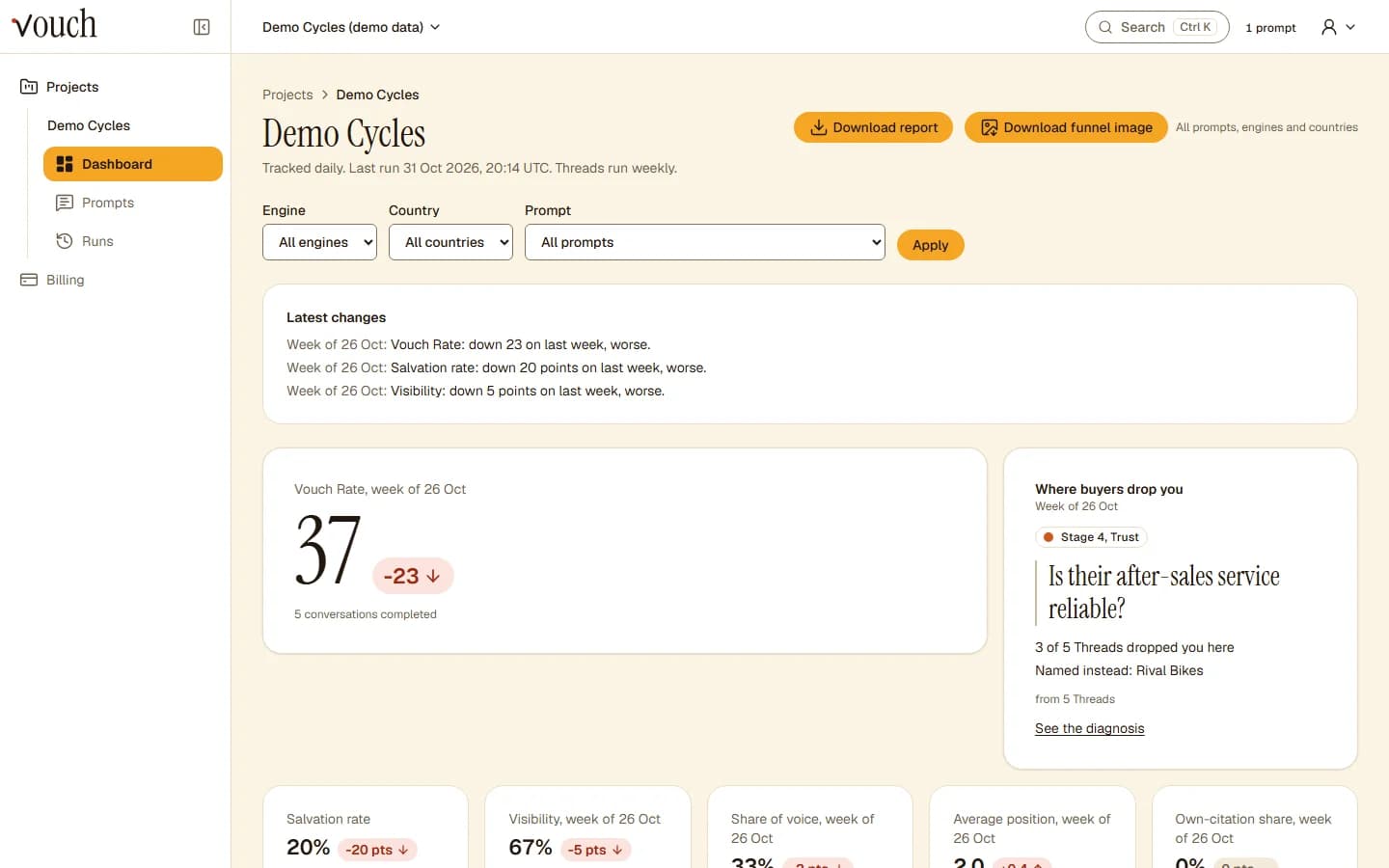
Every day, Vouch asks your tracked prompts across seven AI assistants. Three times a week it also runs Threads, six-question buying conversations, on ChatGPT, Claude, Gemini and Perplexity. Vouch writes the follow-ups for your category, so a Thread for a consultancy asks what a buyer would: who has relevant experience, what the downsides are, whether the firm is credible, whether it is worth the fee and who to contact. Each run records where your firm drops out, who is named instead and the sources cited, and suggests what to publish. The weekly Vouch Rate tracks the trend; the methodology explains how.
Common questions
Do B2B buyers use AI assistants to find agencies or consultancies?
Some do. A buyer describes a problem and asks who can solve it, then asks about relevant experience, how the firm charges and whether it is credible before getting in touch.
Why is my firm never mentioned when buyers ask AI for providers?
Often because the public record is thin: no detailed case studies, vague service descriptions, little third-party coverage. An assistant recommends with more confidence the firms it can describe with evidence.
Do case studies matter for AI visibility?
Yes. They are the proof an assistant can quote when a buyer asks whether you have done this before: who you helped, what you did and what changed. A wall of logos gives it nothing to say.
Should a service firm publish its prices?
Full rate cards are rare in services, but honest guidance helps: how you charge, typical starting points and project sizes, and what changes the cost. An assistant that can frame your cost can keep you in the conversation.