
How AI Assistants Compare Brands at the Shortlist Stage
By Vouch6 min read
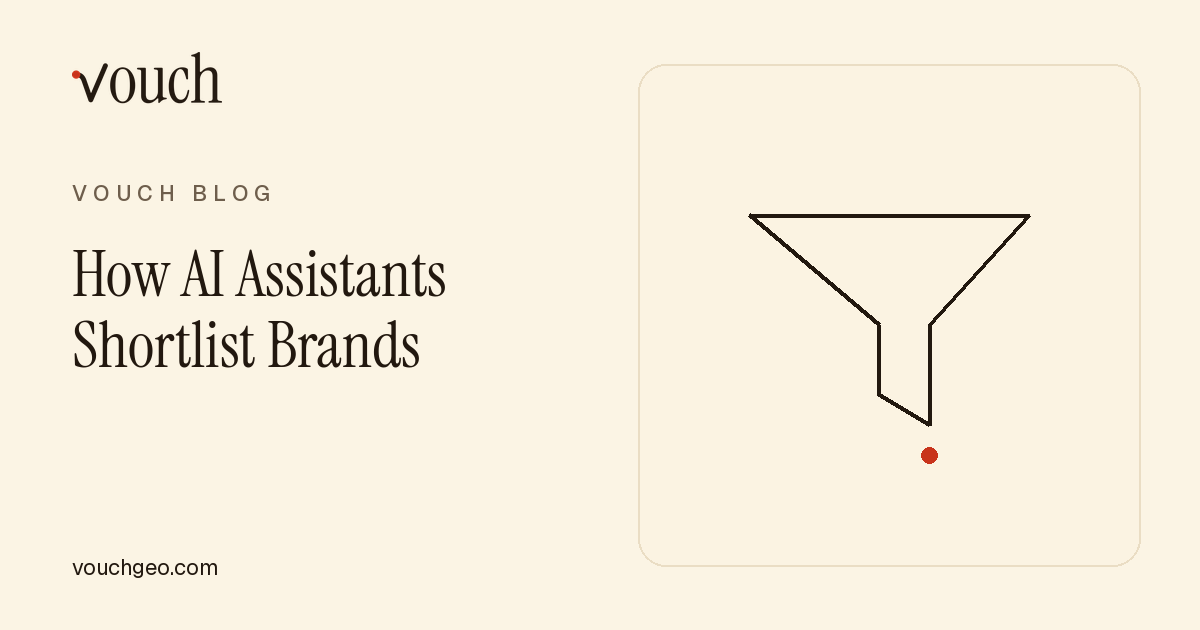
Most AI visibility advice is about the first answer: does the assistant name you when a buyer asks for the best options? The next message is where the list gets cut. The buyer adds their own conditions ("which of these work in the rain?", "which fit a 30-dollar budget?", "which integrate with what we use?") and the assistant has to choose between brands, not just list them.
That second question is the Shortlist stage of a buying conversation. This guide looks at what an assistant has to work with at that moment, why brands fall off, and what you can publish so yours stays on. For the whole six-stage journey, start with what happens after the first answer.
What changes at the shortlist
At discovery, an assistant can name a brand from general reputation. At the shortlist it has to state facts that match the buyer's conditions, and it can only state what it can find.
Some of the mechanics are documented. Google says AI Mode and AI Overviews may use a query fan-out technique, running several related searches across subtopics and sources to build one response, according to its AI features guide. A shortlist question with three conditions can become several searches, one for each. OpenAI's shopping help page says ChatGPT's product results draw on structured metadata such as price and description, plus third-party content, and that labels like "budget-friendly" can mean reviewers often mention good value. In both cases, a fact that is published and easy to find is a fact the assistant can use.
A worked example
Take a buyer replacing a commuter bike. She asks for the best hybrid bikes under 800 pounds and gets five names, including two invented brands we will follow: Demo Cycles and Rival Bikes.
Then she narrows it: "I ride in all weather and I hate maintenance. Which of these hold up best in the rain?"
Demo Cycles has a page for each model listing hub gears, hydraulic disc brakes and puncture-resistant tyres, plus a guide to riding through winter. Reviewers repeat those details. The assistant can say why it fits.
Rival Bikes has striking photography, the word "premium" on every page and its specifications in a downloadable PDF. The assistant finds little it can state, so it hedges: "less information is available about its components". The buyer reads the hedge as a warning, and Rival Bikes drops out of a conversation it never knew was happening.
Three reasons brands fall off
This is our working model from running these conversations, not a documented algorithm. It is still a useful way to find gaps.
1. The fact exists but cannot be read
The buyer states a condition and the assistant needs your version of the fact. Prices inside images, specifications in PDFs, compatibility lists drawn by a script after the page loads: each can leave the assistant unable to confirm that you qualify. Many AI crawlers do not run JavaScript at all, as the AI crawler readiness checklist explains.
2. The proof is thin
For qualitative questions ("which is more reliable?") the assistant turns to reviews, expert coverage and owner discussions. A brand with a handful of reviews is hard to recommend with confidence, however good the product.
3. The facts disagree
If your site, a retailer and a comparison article give three different prices or specifications, the assistant has to pick one or hedge. Old pages, out-of-date marketplace listings and a half-finished rebrand all create these conflicts.
Why nobody notices
Shortlist losses are silent. The assistant does not announce that a brand has been dropped; it simply carries on discussing the ones it can say things about. Your rankings do not move and your mention count for the opening prompt looks fine. Only following the conversation past the first answer shows it.
How to stay on the shortlist
- Publish every buying fact as text on the page. Price, specifications, compatibility, sizes, coverage, stock and returns. The product page checklist works through it item by item.
- Write the comparison yourself. An honest "us versus them" page, including where the rival wins, gives the assistant material for the exact comparison buyers ask for. A one-sided page is easy for third-party content to contradict.
- Build the review base early. Reviews that mention specifics ("survived a Scottish winter", "set up with our CRM in a day") are the kind of detail an assistant can repeat.
- Make the facts agree everywhere. Check your site, marketplace listings and directory profiles against each other every quarter.
- Plan for the next question. Surviving the shortlist earns you the objections, the trust check and the price question. Why your brand disappears in follow-up questions covers those stages.
A ten-minute self-test
Ask an assistant for the best options in your category. Then add three conditions your buyers really use, one at a time, and finally ask which it would pick for your ideal customer. For each condition, note whether your fact was stated correctly, stated wrongly or not stated. Run the same test for your two closest rivals. If they have the same gaps, fixing yours first is an opening; if they do not, the assistant can already say things about them that it cannot say about you. The 30-minute AI visibility audit extends this into a fuller check.
Seeing it every week
Vouch runs this conversation for you. Each Thread is six questions long, from Discovery through Shortlist to Decision, and runs three times a week on ChatGPT, Claude, Gemini and Perplexity. It records the stage where your brand is dropped, the brands kept instead and the sources cited at that point. The methodology explains how a conversation is scored.
Vouch is invite-only today. Join the waitlist for an invitation, which starts with a 14-day free trial.