
The First Answer Is Not the Sale: What Happens After the Prompt
By Vouch4 min read
Most AI visibility advice obsesses over the first answer: did ChatGPT name your brand for "best X under Y"? It is a reasonable place to start, and a terrible place to stop.
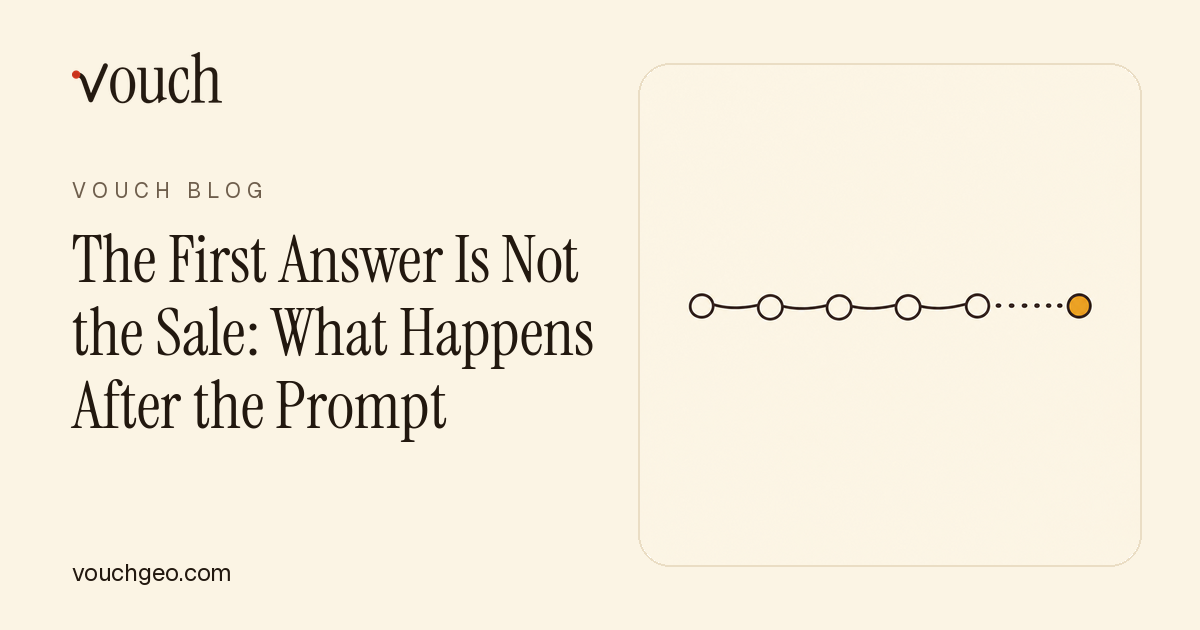
Watch how people often buy with an assistant. They get the first answer, glance at the shortlist, and keep going. "Compare the top three for my use case." "What are the downsides of the first one?" "Is their after-sales service reliable?" "Is it worth the price?" "Which one should I buy, and where?"
That is not one answer. It is a six-question conversation, and a brand can be winning at question one and gone by question four.
The six stages: a framework for the AI buying conversation
No buyer follows a script, but the pattern repeats enough that we built Vouch around it as a diagnostic framework:
- Discovery. The opening question: "what are the best electric cycles under 50,000?" Four or five brands get named. This is the stage everyone measures.
- Shortlist. "Compare the top three for daily commuting." The assistant narrows the field. One brand is already gone.
- Objection. "What are the downsides of the first one?" The assistant surfaces complaints, limitations and bad reviews. Brands with unresolved criticism bleed here.
- Trust. "Is their after-sales service reliable?" Warranty, support, real owner experiences. This is where thin online reputations get exposed.
- Value. "Is it worth the price over the others?" The assistant weighs cost against everything it knows.
- Decision. "Which one should I buy, and where?" One recommendation. This is the only stage that directly becomes revenue.
Being named at Discovery is table stakes. The sale happens at Decision, and the path between them is where brands silently lose.
A familiar example
Say four brands open the conversation. Yours survives the shortlist and the objection round. Then the buyer asks about after-sales service, and the assistant answers with three forum threads about slow repairs. Your brand is not criticised into oblivion; it is simply not recommended. The buyer never tells you. Your analytics never show it. The sale went to the rival whose service story was documented and cited.
Multiply that by every buyer, every prompt, every assistant, every week.
Why existing tools miss this
First-generation AI visibility tools count mentions and positions in single answers. Useful, but structurally blind: they cannot see that you were named first and still lost the sale four questions later. The metric that matters is not "were you mentioned" but "how far do you survive."
How to survive the whole conversation
Map your content against each stage:
- Discovery: category pages and comparison coverage so you are named at all.
- Shortlist: a clear use-case story. "Best for commuting" beats "great product."
- Objection: address the known complaints head-on. A page that honestly answers "downsides of X" beats ten forum threads answering it for you.
- Trust: after-sales, warranty, service network, real reviews, in writing, on your site and on the review platforms assistants read.
- Value: a pricing page that justifies the price against alternatives, not one that hides it.
- Decision: an obvious, crawlable place to buy, with accurate price and stock.
Then measure it. Run your real buyer prompts, ask the follow-ups a buyer would ask, and record the stage where you drop out. That stage is your content roadmap.
This is exactly what we built Vouch to do. A Thread is one buyer's conversation, six questions long, run across ChatGPT, Claude, Gemini and Perplexity every week. Vouch shows where you survive, where you drop out, who replaced you, and what to publish to win that stage back.
See where your brand drops out with Vouch: join the waitlist, and every invitation starts with a 14-day free trial.