
GEO vs SEO vs AEO: What Is Actually Different
By VouchUpdated 4 min read
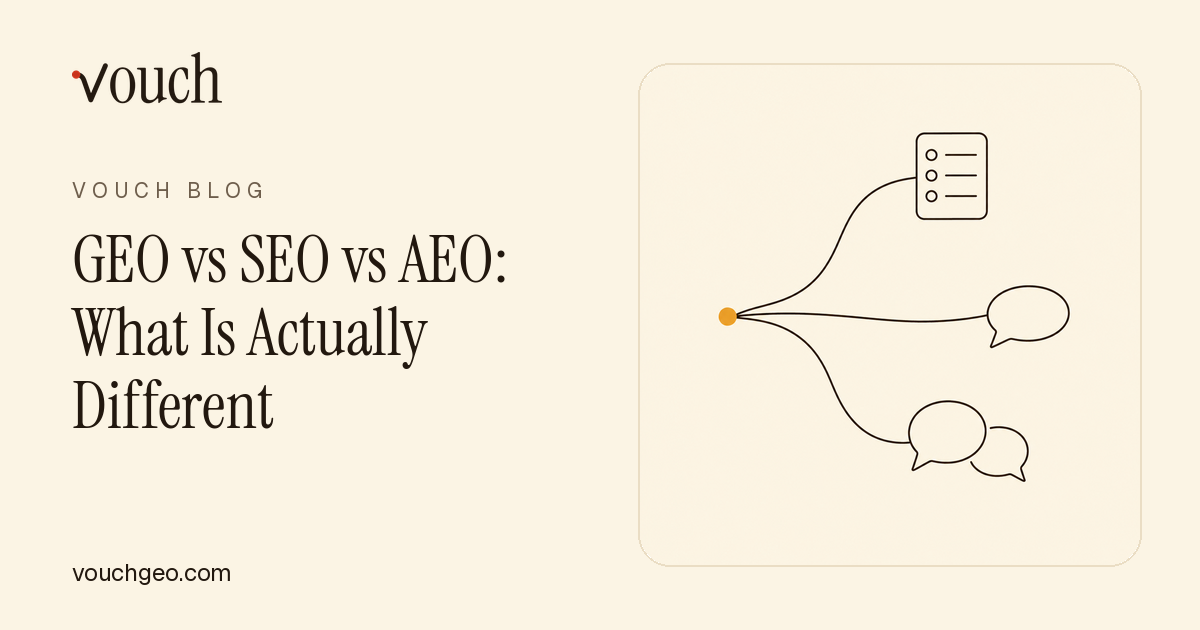
Three acronyms now describe how brands get found, and they are easy to blur together. SEO optimizes for ranked links. AEO, answer engine optimization, optimizes for direct answers in search features. GEO, generative engine optimization, optimizes for what AI assistants say about you.
They share foundations, but they are not the same job. Here is the honest breakdown.
SEO: compete for position
Search engine optimization is the oldest discipline of the three. Google crawls and indexes your pages, then ranks them against competitors for a query. You win by reaching the top positions, because clicks concentrate there.
The unit of competition is the ranking. The output you optimize is a list of links. The feedback loop is mature: rankings, impressions, clicks.
SEO is not dead. Google still sends the overwhelming majority of search traffic, and AI assistants lean heavily on traditional search indexes when they retrieve pages. Everything below builds on SEO, it does not replace it.
AEO: compete for the direct answer
Answer engine optimization emerged when search engines started answering questions on the results page itself: featured snippets, knowledge panels, People Also Ask boxes, and later voice assistants.
The unit of competition is the answer box. You win by structuring content so the engine lifts yours: clear definitions, question-format headings, concise answers near the top of the page, structured data.
AEO accepted a trade SEO resisted: the user might never click. The value is visibility and authority on the results page, not the visit.
GEO: compete for mention, citation and recommendation
Generative engine optimization starts where AEO ends. ChatGPT, Claude, Gemini, Perplexity, Google AI Overviews, AI Mode and Copilot do not show a snippet of your page. They read many pages and write a new answer.
The Princeton and IIT Delhi study that coined GEO tested what makes content more visible inside these generated answers. Citing sources, adding statistics and adding quotations helped most, as our GEO explainer sets out. Keyword stuffing hurt.
The unit of competition splits into three:
- Mention: the answer names your brand
- Citation: the answer links your site as a source
- Recommendation: the answer advises the user to choose you
And there is a structural difference nobody should gloss over: assistants hold conversations. A buyer asks for the best options, then asks to compare them, then asks about the downsides, reliability, price and where to buy. You are not competing in one answer. You are competing in six.
Side by side
| SEO | AEO | GEO | |
|---|---|---|---|
| Output | Ranked list of links | Answer box on the results page | Synthesized AI answer, plus follow-ups |
| You compete for | Position | The snippet | Mention, citation, recommendation |
| Success metric | Rankings, clicks | Snippet ownership | Mention rate, citation rate, recommendation rate |
| Content signal | Relevance and authority | Structure and clarity | Credibility: sources, statistics, quotes |
| Feedback loop | Search Console | Manual checks | Repeated AI answer tracking |
What to keep and what to add
Keep doing SEO. Assistants retrieve from search indexes, so a page Google cannot rank is often a page ChatGPT never sees. Keep the AEO habits too: clear, well-structured answers are exactly what a generative engine can lift and cite. Plain definitions of all three terms, and the rest of the vocabulary, are in the Vouch glossary.
Then add the GEO layer:
- Make every key page citable. Add the statistic, the definition, the quotable line. Assistants prefer content they can attribute.
- Show up where assistants form opinions. Comparisons, reviews, forums and directories feed AI answers. Your own site is one voice among many.
- Measure mentions and recommendations, not just traffic. AI referral visits are growing fast, but the answer itself is the bigger surface. Track what assistants say about you weekly, across more than one assistant, because they cite different sources and recommend different brands.
- Follow the conversation. Check not only whether you are named first, but whether you survive the follow-up questions about downsides, trust and price.
That last point is where the field is heading. A brand can be mentioned in the first answer and gone by the fifth question. We built Vouch to track exactly that journey, stage by stage, across ChatGPT, Claude, Gemini and Perplexity.
See where your brand drops out with Vouch: join the waitlist, and every invitation starts with a 14-day free trial.