
AI SEO agency: what they do, the red flags and how to choose one
By Vouch7 min read
Search "AI SEO agency" and you will find hundreds of firms promising to get your brand recommended by ChatGPT, Perplexity and Google AI Overviews. Some do serious work. Some have repackaged classic SEO with new slide decks. Telling them apart matters, because the retainer costs the same either way.
This guide covers what an AI SEO agency genuinely does, the red flags that separate substance from rebrand, the questions to ask before you sign, and when a measurement tool beats an agency altogether.
What an AI SEO agency actually does
Start with a grounding fact: Google's own documentation says AI features such as AI Overviews and AI Mode need no special markup or files beyond good search fundamentals, as of November 2026. So a credible agency's work splits in two.
The classic half is unchanged: technical health, crawlability, content quality, authority. The new half is specific to AI answers:
- Prompt research: mapping the questions buyers actually ask assistants in your category, the AI equivalent of keyword research.
- Citation gap analysis: finding which sources assistants cite for those questions and why your pages are absent.
- Content for citability: restructuring pages so answers are easy to extract. A Princeton-led study of generative engines found that adding citations, quotations and statistics improved visibility in AI answers by up to 40 per cent in its tests, as of November 2023.
- Measurement: running prompts repeatedly across engines and tracking mentions, citations and recommendations over time, which is the part most retainers skip.
- Digital PR and third-party mentions: assistants lean on sources beyond your site, so agencies earn coverage in the publications and communities those engines already cite. This is slow, unglamorous work, and it is often where an agency adds the most value.
A short test to run before the pitch
Walk into the first meeting with your own baseline. Pick ten questions a real buyer would ask: "best X for Y", "X vs Y", "is X worth it", "X alternatives". Run each one in ChatGPT and Perplexity, and in Google where an AI Overview appears. Note where your brand is named, where a rival is named instead, and which pages get cited. Twenty minutes of this tells you three things: how visible you actually are today, which rivals the engines favour, and whether the agency's pitch matches the reality you just saw. A pitch that opens with problems your test did not reproduce deserves a sceptical question.
Our guide to AI SEO covers the underlying discipline if you want the full picture first.
First, decide whether you need an agency at all
Google has published a plain guide to the question: Do you need an SEO?. Its advice still holds for the AI variant: an outside specialist earns its fee when you lack the time or skill in-house, and a good one educates rather than mystifies.
This is an editorial recommendation, not a rule: hire an agency when you need content production, digital PR and technical change at scale. Skip the retainer when your real gap is measurement, because no agency can manually check hundreds of prompts across seven engines every day, and tools do that better and cheaper. Many brands end up with both: a tool for the numbers, an agency for the workload. If the tools route fits, our roundup of the best AI visibility tools is the place to compare.
Red flags when you evaluate agencies
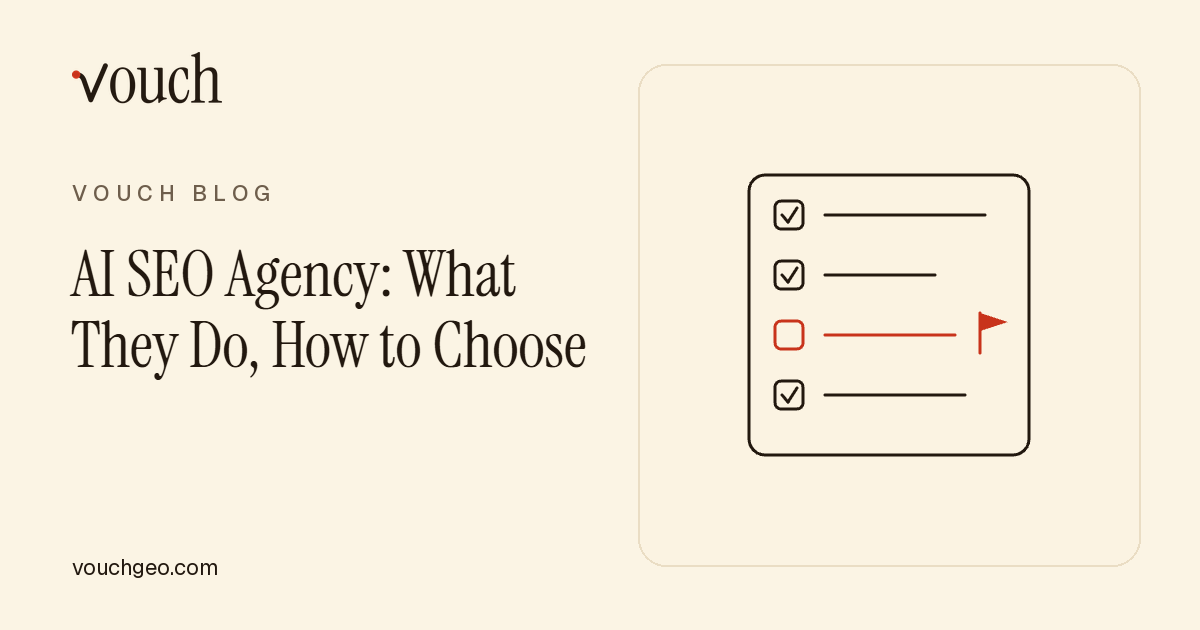
Four patterns should end a sales call early:
- Guaranteed placements. No one can guarantee that ChatGPT or AI Overviews will recommend you, because assistants sample different sources and give different answers run to run. Our guide to AI search visibility explains why a single answer proves nothing. An agency promising a fixed position is selling certainty that does not exist.
- Secret GEO tactics. There is no hidden file or tag that unlocks AI answers, per Google's documentation above. Ask what the tactic actually is; if the answer is proprietary fog, walk away.
- Screenshot reporting. A cherry-picked screenshot of your brand in one ChatGPT answer is marketing, not measurement. Serious reporting shows prompt sets, run counts and trends.
- Case studies you cannot verify. Invented wins are easy to write. Ask for references you can call, and be suspicious of precise percentage uplifts with no methodology behind them. A serious firm explains how it measured the result before it quotes the number.
The questions to ask before you sign
Bring this list to the pitch meeting:
- Which engines do you track? The credible minimum covers ChatGPT, Perplexity, Gemini, Google AI Overviews, AI Mode and Copilot, because buyers use all of them.
- What prompt set will you run, and how often? Look for a defined list of buyer questions, run multiple times a week, with the list shared with you.
- How do you separate mentions from citations? A named mention and a clickable citation are different outcomes with different value, and the reporting should never blend them.
- How do you handle variance? The right answer involves repeated runs and trends over snapshots. The wrong answer is silence.
- How will you connect this to business results? Expect a plan that includes AI referral traffic in analytics; our guide to measuring AI referral traffic in GA4 shows what that setup looks like.
- What is your policy on AI crawlers? Blocking the wrong bot can limit eligibility for answers you are paying to appear in; the trade-offs are laid out in should you block GPTBot.
- Who owns the data if we part ways? The prompt set, the run history and the baseline are yours. Make sure the contract says the records leave with you, or you restart from zero with the next partner.
- Who actually does the work? Ask whether the people in the pitch are the people on the account, and how much of the delivery is junior staff or outsourced.
What good measurement looks like
Whether you hire an agency or not, hold the reporting to this standard: weekly runs of a fixed prompt set across engines, mention and citation rates tracked separately, and month-on-month trends rather than daily noise. Where official data exists, use it: Bing Webmaster Tools' AI Performance report shows citation counts for Microsoft's AI answers, as of February 2026, while Google still blends AI Overviews traffic into Search Console's "Web" search type with no separate breakout, as of November 2026. An agency working around those gaps should say so plainly.
How Vouch helps
Vouch is the measurement layer, whether you work with an agency or in-house. Single prompts run daily across all seven tracked engines: ChatGPT, Claude, Gemini, Perplexity, Google AI Overviews, Google AI Mode and Copilot. Threads, six-question buyer conversations run on ChatGPT, Claude, Gemini and Perplexity, show where your brand drops out between the first answer and the final recommendation, and the Vouch Rate, from 0 to 100, rolls stage survival and final choice into one number.
If you do hire an agency, Vouch gives you an independent record of the same prompts, so you can verify the retainer's claims against your own data. Plans start at $29 a month with a 14-day trial, and sign-up is invite-only through the Vouch waitlist, as of November 2026.