
Copilot ads: how advertising in Microsoft Copilot works
By Vouch8 min read
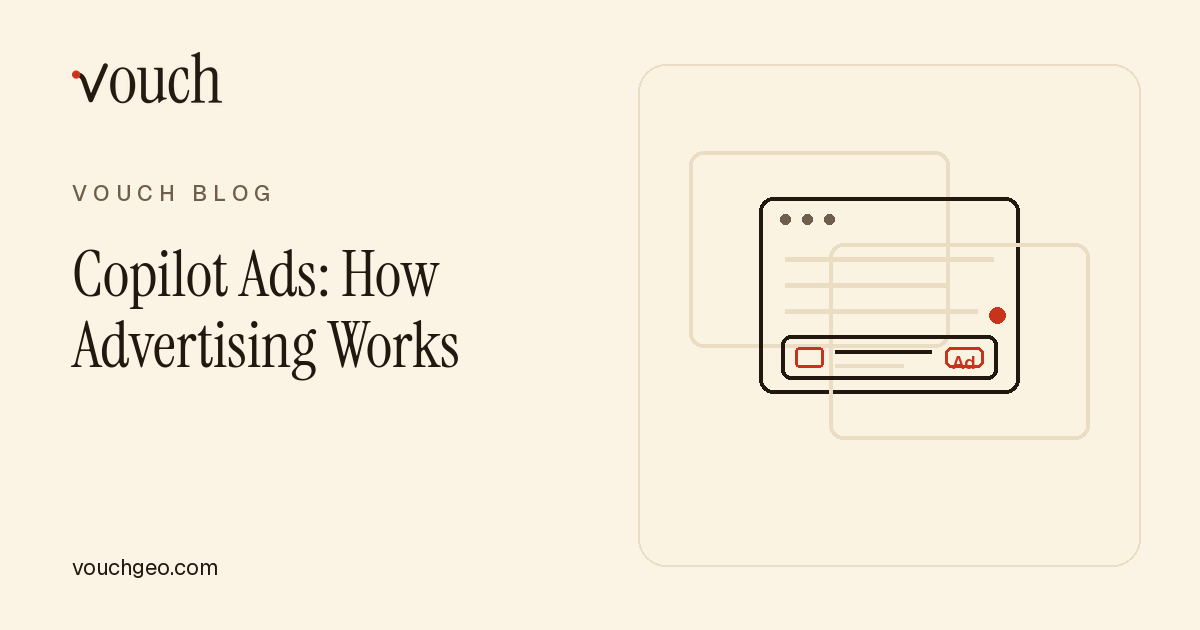
Copilot is one of the AI assistants your buyers now use to research products, and it carries advertising. Microsoft serves ads inside Copilot's answers, but there is no Copilot campaign type to switch on. The ads come from campaigns you already run in Microsoft Advertising, assembled automatically from your existing assets. This piece covers what serves, how Microsoft chooses which ad appears, what you can measure, and what to do about it.
Are there ads in Microsoft Copilot?
Yes. Microsoft's own documentation says Microsoft Advertising "serves ads in varying formats which are displayed in Copilot's responses", and those ads are created automatically from your campaign's existing text and image assets (About ads in Copilot, Microsoft Learn, as of November 2026).
Three details in that documentation matter for planning:
- All eligible campaigns and ad types are automatically opted in to serving in Copilot.
- Advertisers cannot opt out of serving in Copilot.
- There is no guarantee that any given ad will be displayed.
So if you run Microsoft Advertising today with eligible formats, your ads can already appear in Copilot, whether or not you have thought about it as a channel. The question is not whether to join. It is whether your campaigns are in good shape for a conversational placement you did not design them for.
Which campaigns and ad types are eligible?
As of November 2026, Microsoft lists these as eligible to serve in Copilot:
- Multimedia ads
- Product ads, including Shopping campaigns and Performance Max campaigns serving product ads
- Search ads that carry a logo extension or an automated business logo, including Dynamic Search ads, Responsive Search ads and Performance Max ads in search placements
- Two vertical ad types: Property promotion ads and Tours and Activities ads
The logo point is easy to miss. A search ad without a logo is not eligible for Copilot at all, so adding one is the single cheapest eligibility fix in the account.
Negative keywords carry across too. Microsoft says negative keyword matching works in Copilot the same way it does for web searches on the Microsoft Advertising Network, so the exclusions you have already set keep applying in chat.
How Microsoft chooses which ad to show
The selection logic is built for conversation. In its FAQ, Microsoft says it considers "the context of the entire conversation, not only the last prompt", and that after Copilot has resolved the initial query it uses what it knows about the user to surface ads that are relevant to them and to the audiences advertisers are targeting (About ads in Copilot, Microsoft Learn, as of November 2026).
That is a real difference from classic search. A buyer who has spent four follow-ups narrowing down options has given Copilot far more context than a single keyword ever did, and the ad selection can use all of it. It is the paid mirror of the pattern we see on the organic side: the follow-up questions, not the first answer, are where the decision forms.
On brand safety, Microsoft says its models flag potentially harmful content in queries or generated responses, and ads are not shown in flagged conversations. Restricted categories follow the same rules as on Bing: ad copy is not truncated, so terms and conditions still show, and prescription pharmaceutical ads require their usual disclaimers.
What changed in 2026: AI Max, Offer Highlights and checkout
In April 2026, Microsoft Advertising laid out its AI-era ads roadmap in a post titled Win across all three eras of the web. Three parts of it touch Copilot directly:
- AI Max for Search campaigns. In open pilot from May 2026, AI Max uses AI for expanded query matching, asset personalisation and smarter URL routing. Microsoft positions it as a way to deliver relevant ads on AI surfaces, naming Copilot Search and Copilot Answers alongside Bing. Advertisers opt in, and Microsoft says search term and asset reporting is available from the start, with guardrails such as brand inclusions and exclusions to follow.
- Offer Highlights. New ad experiences that let brands promote specific product differentiators, such as free delivery or in-store pickup, within the context of a Copilot conversation. Available for retail use cases in English-speaking markets, appearing on product detail pages in Copilot, Edge and Bing, with the differentiators supplied through Microsoft Merchant Center. Best Buy was among the first to activate them.
- Copilot Checkout and catalogue integrations. Copilot Checkout lets shoppers complete a transaction inside Copilot while the merchant stays the merchant of record. Microsoft says catalogue data has deepened to more than 500,000 merchants, with Target as an early loyalty partner, and a Shopify Catalog integration brings Shopify merchants' products into Copilot with real-time pricing and inventory. Microsoft reports that top Shopify merchants saw nearly 90% growth in impression share in Copilot from these feeds, an early result it published in April 2026.
The context Microsoft gives for all of this is the growth of agent traffic: it says automated traffic is growing eight times faster than human traffic, that AI-driven sessions nearly tripled in 2025, and that agentic browser traffic is up roughly 8,000% year on year. Treat these as Microsoft-reported figures from April 2026, not independent measurements, but they explain why Copilot is getting paid formats quickly.
The measurement gap
Here is the uncomfortable part. Microsoft's documentation states plainly: "Microsoft Advertising does not currently support specific metrics for ads served in Copilot."
As of November 2026, that means you cannot pull a report that isolates Copilot impressions, clicks or spend from the rest of the Microsoft Advertising Network. Your Copilot delivery is folded into campaign totals. If performance shifts, you cannot confirm from reporting whether Copilot was the reason.
Practical implications, which are editorial recommendations rather than documented features:
- Judge Copilot contribution through overall campaign movement, not a Copilot line item that does not exist.
- Keep the organic and paid questions separate in your reporting. Paid serving tells you nothing about whether Copilot recommends you when no ad is involved.
- Watch Microsoft's announcements. Given that AI Max ships with search term reporting, Copilot-specific measurement is a plausible candidate for future releases, but Microsoft has promised nothing.
Paid placement and organic visibility are different jobs
Copilot ads buy you a sponsored slot in the answer. They do not buy a mention in the answer itself. Whether Copilot names your brand organically, cites your pages, or keeps you in the conversation through the follow-up questions is a separate outcome, earned through your content and your citations.
That organic layer is measurable, and the taxonomy is settled: mention rate, citation rate, survival across the conversation and recommendation at the decision stage, as laid out in our guide to AI search visibility. If you want to start measuring the organic side, our piece on how to track brand mentions in AI search walks through the methods, and how ChatGPT Shopping chooses products and brands shows what the organic selection process looks like in practice on the shopping side.
One honest caution: do not assume running ads lifts your organic mentions in Copilot. Microsoft documents no such link, and the two systems select on different signals.
What to do now
Six actions, all from the documentation and announcements above:
- Add a logo to every search campaign. Without one, your search ads cannot serve in Copilot at all.
- Use Performance Max where it fits your goals. Microsoft says it gives Copilot the most assets and variables to match against conversational intent.
- Audit your negative keywords. They apply in Copilot exactly as they do in search, so stale exclusions now gate a chat surface too.
- Retail brands: fill in Merchant Center differentiators. That is the input Offer Highlights use, and UCP-ready feeds in Merchant Center are now generally available in the US.
- Evaluate the AI Max pilot if expanded query matching on Copilot Search and Copilot Answers suits your account, using its search term reporting to watch where you actually serve.
- Measure your organic Copilot presence separately. Paid and organic visibility need different dashboards, because Microsoft gives you no Copilot-specific paid metrics.
How Vouch helps
Vouch measures the organic half of this picture. It tracks your brand across seven AI assistants on every plan, including Copilot, with single prompts running daily. Threads follow a six-question buying conversation (Discovery, Shortlist, Objection, Trust, Value, Decision) on ChatGPT, Claude, Gemini and Perplexity, recording where your brand drops out and who replaces it. Everything rolls up into the Vouch Rate, a 0 to 100 score built from how many stages your brand survives and whether it is chosen at the end.
That gives you the number Microsoft does not: not how often your ad served, but how often Copilot and its peers recommend you when no ad is involved. Vouch is invite-only for now, and every invitation starts with a 14-day free trial. You can also check which AI crawlers can reach your site with the free AI crawler checker.