
Perplexity ads: why the answer engine dropped advertising
By Vouch7 min read
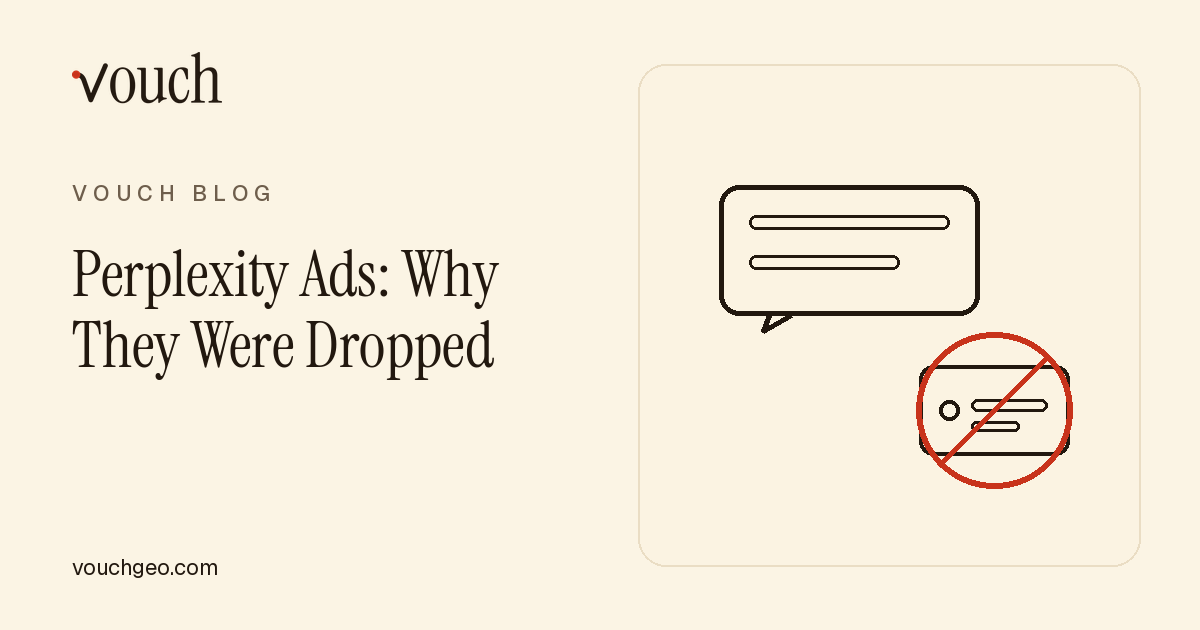
If you are searching for Perplexity ads in November 2026, the answer has changed twice in two years. Perplexity was one of the first AI answer engines to test advertising, and then one of the first to walk away from it. That reversal matters for brands, because it leaves exactly one route into Perplexity's answers: being cited on merit.
This guide covers what Perplexity tested, why it stopped, how the AI advertising landscape now splits, and what to do about Perplexity visibility when you cannot pay for it.
What Perplexity tested
Perplexity announced its advertising experiment on 12 November 2024 in its own post, Why we're experimenting with advertising. The format, as described at launch:
- Sponsored follow-up questions: paid questions placed after an answer, clearly marked as sponsored. Answers to those questions were still generated by Perplexity's technology, not written or edited by the sponsoring brand.
- Paid media beside answers: placements positioned to the side of an answer, in the US to start.
The launch partners included Indeed, Whole Foods Market, Universal McCann and PMG, per the same announcement. Perplexity's stated principles mirrored what AI platforms say today: ads would not influence answers, and personal information would never be shared with advertisers. The revenue logic was publisher revenue sharing, which subscriptions alone could not fund, the company said at the time.
One line from that 2024 post reads differently now. Perplexity said it wanted to "avoid duplicating the SEO industry where people are implementing arbitrary tactics to improve their rankings", and offered advertising as the transparent alternative to manipulating answers. Two years later it concluded that even transparent ads carried a trust cost it did not want to pay.
What happened: the phase-out
In February 2026, the Financial Times reported that Perplexity had phased out the ads it began testing in 2024 and had no plans to bring them back, as covered by Search Engine Land. The company could revisit advertising or "never ever need to do ads", the report said.
The reasoning, per executives quoted in that report, is trust. "A user needs to believe this is the best possible answer," one executive said; once ads appear, users may second-guess the integrity of the response, whatever the labelling. Perplexity described subscriptions as its core business, with paid plans from $20 to $200 a month, more than 100 million users and about $200 million in annualised revenue, according to the same report. The company had previously reported 780 million monthly queries, and its shopping features take no cut of transactions.
How the AI ads landscape splits now
As of November 2026, the major AI assistants divide into two camps:
| Platform | Advertising status |
|---|---|
| ChatGPT | Ads live in 89 countries on Free and Go tiers, per OpenAI's October 2026 expansion announcement |
| Ads run in AI Mode and AI Overviews within Search, though not in Gemini, per the February 2026 Financial Times report | |
| Perplexity | Ad-free after phasing out its 2024 test, per the same report |
| Claude | Anthropic has publicly committed to keeping Claude ad-free, per the same report |
The split is not a temporary gap between early and late movers. It reflects two different bets: ChatGPT and Google treat ads as a way to fund free access, while Perplexity and Anthropic treat ad-free answers as the product itself. Both positions can hold for years.
Why the reversal matters beyond Perplexity
AI answers live or die on perceived objectivity. A classic search results page carries ads at the top and nobody assumes the tenth blue link was bought, but a single synthesised answer is different: it reads like advice, and advice with a commercial layer invites the question of who paid. Every AI platform now has to answer that question in its own way. OpenAI's answer is explicit answer independence, with ads always labelled and separate, per its ads principles. Perplexity's answer, as of February 2026, is to remove the commercial layer entirely.
For brands, the practical lesson is not that one bet is right and the other wrong. It is that the ground rules of every AI channel can change within a year, so any strategy that depends on a single platform's current policy is fragile.
How to earn citations in Perplexity
With no paid route in, the work is editorial. What tends to earn citations, based on Perplexity's own positioning as an answer engine that searches the web in real time:
- Answer the question directly, early on the page. An engine that quotes sources needs passages worth quoting.
- Add the evidence answers lean on. A Princeton-led study of generative engines found that adding citations, quotations and statistics to content improved visibility in AI answers by up to 40 per cent in its tests, as of November 2023.
- Keep pages fresh and crawlable. Real-time retrieval favours maintained pages, and a blocked crawler ends your eligibility before quality is judged. The trade-offs are in should you block GPTBot, and the free AI crawler checker confirms access.
- Build presence beyond your own site. Answer engines lean on third-party sources, so coverage in publications and communities they already cite carries weight.
What this means for brands
This is an editorial recommendation rather than a rule. Three practical consequences:
- Perplexity visibility is earned, never bought. There is no sponsored placement, no preferred partner slot, no paid shortcut into the answer. What Perplexity cites is what it judges worth citing, which makes its source selection the whole game. Our guide to how Perplexity chooses sources covers what gets picked.
- Do not write off ad-free audiences. Perplexity's bet only works if users keep coming, and buyers doing deep research often prefer an answer engine with no commercial layer at all. The audience you reach through citations there can be precisely the one comparing options carefully.
- Track each platform separately. Your brand can be cited constantly in Perplexity and absent from ChatGPT, or the reverse, and the levers differ per engine. The measurement framework in AI search visibility and the method in tracking brand mentions in AI apply platform by platform.
- Keep paid AI budgets honest. Where ads do exist, judge them on your own measurement rather than launch headlines: OpenAI added Conversions API support and named attribution partners in its October 2026 measurement update, so capped tests with clear conversion tracking are possible.
How Vouch helps
Vouch measures how AI assistants recommend your brand, and Perplexity is one of the seven engines tracked on every plan. Single prompts run daily across ChatGPT, Claude, Gemini, Perplexity, Google AI Overviews, Google AI Mode and Copilot. Threads, six-question buyer conversations that run on ChatGPT, Claude, Gemini and Perplexity, show where your brand drops out between the first answer and the final recommendation, and the Vouch Rate, from 0 to 100, rolls stage survival and final choice into one number.
On an ad-free engine, that organic record is the only record. Plans start at $29 a month with a 14-day trial, and sign-up is invite-only through the Vouch waitlist, as of November 2026. You can also confirm that Perplexity's crawlers can reach your site with the free AI crawler checker.